
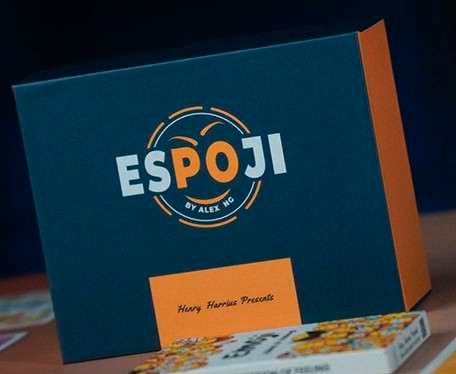
 Each card is also cleverly marked on their back. One mark tells you the identity of the emoji on the face. There is another mark on the same back that tells you the identity of emoji before this one.
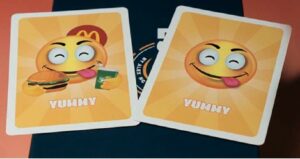
There are 3 more specially printed cards supplied: one is a double-backer with white background on one side and green background on the other side. There are 2 Yummy emoji cards – each card containing the Yummy emoji with McDonald’s hamburger and sprite. One card has the white back while the other card has the dark green back.
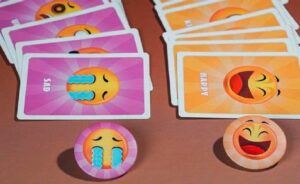
In addition to the cards, you receive 2 badges: one has the sad emoji and one has the happy emoji. You are also given a double packet card holder made of leather-like material.
 You also get a link to a 84-minute video-tutorial by both Alex Ng as well as Henry Harrius. After introducing the properties of the cards, they teach you 5 different routines with these cards.
- First Love – a spectator freely stops at the “First Love” emoji card.
- Emotional Touch – 3 spectators choose a card each. You are able to divine the emoji of the first spectator, draw a duplicate of the emoji of the second spectator, and read the mind of the third spectator with regards to what the third spectator imagines with her emoji.
- Positive/Negative – 2 spectators participate. One holds the “Happy” emoji badge and the other one has the “Sad” emoji badge. You deal each card face down to each spectator. The spectators can either accept or reject the card, without looking at the face. All the rejected cards are gathered into one pile. The cards in this pile are turned over to reveal a mixture of positive and negative emoji cards. The cards from the spectator with the “Happy” emoji badge are turned over to reveal she has chosen all the positive emoji cards. The cards from the spectator with the “Sad” emoji badge are turned over to show that he has chosen all the negative cards. Finally, the spectator with the “Sad” emoji badge is shown the “Worry” emoji card. This card is turn over face down. He takes the “Happy” emoji badge and taps on the back of this card. When it is turned over, it has transformed into the “Happy” emoji card – “Don’t worry – be happy!”
- Empathy – you and a spectator have a packet of 5 emoji cards each. They are the same emoji cards but from a different colour back. Each of you lay your card down one at a time face downwards. You lay down your card first. After all the cards have been laid down, they are turned over face up – every one of them match.
- Card Game – a spectator chooses a card and places it’s back facing to the front on his forehead. You can name his card everytime. He now tries to guess your card and finds that it is not so easy to get it right everytime.
So far, there is no tutorial on the use of the double-back card supplied. Seasoned card magicians will easily find use for this gimmicked card to be used in conjuction with the deck.
As you can see, these 2 emoji decks allow you to perform countless ESP-type mentalism effects. Because these cards are emotion-based, they allow you to interact very meaningfully with your spectators. These emoji cards are a tool for you to develop your own mentalism routines.
